 Jan Montag

Ghost CMS Websites affected - CVE-2026-111497
Womit haben wir es zu tun?
Bei der Schwachstelle CVE-2026-111497 (auch bekannt unter dem Namen Node2Shell oder HTTP2Shell) handelt es sich um einekritische Sicherheitslücke mit hohem Risiko (RCE) im sogenannten Brotli-Decoder. Brotli ist ein weit verbreiteter Algorithmus zur Datenkompression, der im Web genutzt wird, um z. B. HTML- oder JavaScript-Dateien kleiner zu machen und Webseiten schneller zu laden. Das bedeutet die Lücke konkret:
- Das Problem (Buffer Overflow): Der integrierte Brotli-Decoder weist einen Fehler beim Schreiben außerhalb des zulässigen Speicherbereichs auf (Out-of-bounds Write). Wenn ein System eine manipulierten, fehlerhaften Brotli-Datenstrom verarbeitet, schreibt der Decoder Daten in Speicherbereiche, die dafür nicht vorgesehen sind.
- Die Gefahr (Remote Code Execution): Angreifer können diese Schwachstelle ausnutzen, um aus der Ferne beliebigen Schadcode auf dem Server auszuführen, sensible Daten aus dem Speicher auszulesen oder den Dienst komplett abstürzen zu lassen (Denial of Service).
- Warum sie so gefährlich ist: Viele Bibliotheken und Frameworks (wie
fetch()oder Express) dekomprimieren eingehende Brotli-Inhalte vollautomatisch. Ein Angreifer muss dem Server also oft nur eine präparierte Anfrage schicken, um die Lücke zu triggern. Ein funktionierender Konzeptnachweis (Proof of Concept) ist bereits öffentlich verfügbar.
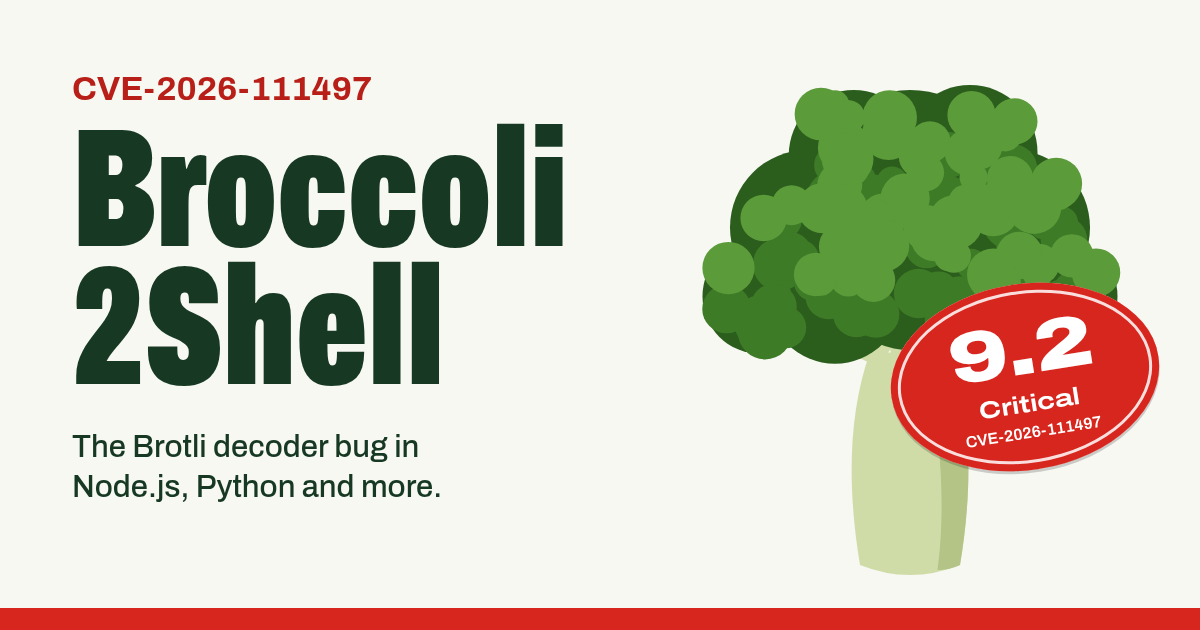
Broccoli2Shell
A bug in the Brotli decoder lets crafted compressed data write past the end of a buffer. Node.js, Python and anything else built on Google's C decoder needs a patch.
Node2Shell evolves to HTTP2Shell. Brotli flaw (CVE-2026-111497) blast radius affects many libraries & apps using HTTPs.
Recall notice
Brotli decoder 1.0.3 through 1.2.0. An out-of-bounds write that can lead to a crash, a memory leak or remote code execution. Rated 9.2 Critical (CVSS 4.0) by GitHub, High by Node.js.
| Product | Affected | Fixed in |
|---|---|---|
| Google Brotli (C library) | 1.0.3 – 1.2.0 | 1.0.10, 1.1.1, 1.2.1 |
| Node.js 26 | below 26.12.1 | 26.12.1 |
| Node.js 24 | below 24.22.1 | 24.22.1 |
| Node.js 22 | below 22.23.4 | 22.23.4 |
| Node.js 25, 23, 20 and older | all versions | No fix. These lines are end of life, so move to 22, 24 or 26. |
Python Brotli | 1.0.3 – 1.2.0 | 1.2.1 |
Python brotlicffi | 1.0.3 – 1.2.0.x | 1.2.1.0 |
Installing the update isn't enough. A running process keeps the old decoder until it restarts, and a container keeps it until you rebuild the image on a patched base and redeploy.
Who's exposed The bug Python Other software Bundled copies Check Fix Exploitation Timeline Why broccoli Sources
Who's exposed
You're at risk if your code, or any library it uses, decompresses Brotli data that someone else controls. That happens in more places than you'd think, because HTTP clients decompress Brotli responses on their own.
- Your app fetches a URLNode's built-in
fetch()decodesContent-Encoding: brresponses automatically. So do Python'srequests/urllib3andaiohttpwhenever a Brotli package is installed. Any server you talk to can send the payload, whether through webhooks, link previews, crawlers or "import from URL" features. - Your app accepts uploads or request bodiesExpress 5.0.0–5.3.0 and body-parser 2.0.0–2.3.0 inflate Brotli request bodies in parsers such as
raw()andjson(). Python frameworks and middleware that decodebrbodies are exposed in the same way. A barenode:httpserver doesn't decode bodies by itself. - Your app calls the decoder directlyThis means
zlib.brotliDecompress*(),createBrotliDecompress(),brotli.decompress(), and any library that uses them on archives, caches or queue messages.
Express and body-parser don't contain the bug. They're just paths to it, so upgrading them won't help. Node.js bundles its own copy of Brotli, which means the system libbrotli doesn't matter there. Only the Node.js version does.
The bug
A Brotli stream is split into blocks, and the decoder switches between block types as it reads them. Before the fix, DecodeBlockTypeAndLength() in c/dec/decode.c returned a plain boolean, so callers couldn't tell a malformed stream from one that just needed more input. On the fast path, the decoder ignored the return value altogether.
A crafted stream can request a block switch that can't happen. The decoder took that to mean "need more input" and kept adding attacker bytes to an eight-byte internal buffer, writing past its end. The overwrite corrupts nearby decoder state. That's how a malformed stream can turn into a memory leak or code execution.
The upstream fix is google/brotli commit 0ed4268, along with 50a9b70, b418fa8 and da98063. It returns a hard format error, BROTLI_DECODER_ERROR_FORMAT_BLOCK_SWITCH (−17), to the caller. The bug is tracked as CWE-252 (unchecked return value) and CWE-787 (out-of-bounds write).
Python
The PyPI packages Brotli and brotlicffi compile the same C decoder. Your code doesn't need to import them to be exposed. If either one is installed, these clients use it on their own:
- urllib3, and therefore requests, advertises
Accept-Encoding: brand decodes Brotli responses. - aiohttp uses Brotli when it's installed.
- httpx uses it through the
httpx[brotli]extra. - Scrapy and other crawlers. Some versions install Brotli as a dependency.
Don't wait for your scanner. When this was disclosed, pip-audit, Dependabot and Safety didn't reliably flag the affected PyPI versions. The CVE record named the upstream Google repository, not the PyPI packages. GitHub's advisory now lists both packages (PYSEC-2026-4322 and PYSEC-2026-4323), but check by hand anyway.
If your bindings come from your Linux distribution (for example python3-brotli) and not from PyPI, the fix arrives through your distribution's security updates.
Other software
The bug is in Google's reference C decoder, not in Node.js or Python. Anything that ships or links Brotli 1.0.3 through 1.2.0 may be affected, even before an advisory names it.
- The system library. It's called
libbrotlidec, packaged aslibbrotli1,brotliand similar. Programs that link it dynamically are fixed once your distribution ships a patched package and you restart them. Statically linked or vendored copies need their own rebuild. - Bindings that wrap the C code. This covers Java JNI wrappers, PHP and Ruby extensions, and Go cgo bindings. Look for a release that bundles 1.0.10, 1.1.1 or 1.2.1.
- Proxies, CDNs, HTTP clients and archive tools that decode
brcontent with the C library.
Decoders rewritten in other languages aren't a concern. The Java, JavaScript and C# ports, which pdf.js, iText and HtmlUnit use, can't reach the bug. The Go port (andybalholm/brotli) had the same logic error, but it would only have crashed, and it was fixed on 23 October. Rust's brotli-decompressor catches the condition and returns an error. Code execution is only possible in the C decoder.
Projects that bundle their own copy
Many projects ship a private copy of the C decoder instead of using your system's library. A distribution update doesn't fix those: each project has to update its copy. We searched GitHub for vendored copies and read their headers on 24 October 2026. A copy is patched if it includes the new BLOCK_SWITCH error code.
| Project | Bundled copy | Untrusted input it decodes |
|---|---|---|
| .NET runtime | 1.1.0 | BrotliDecoder, BrotliStream, and HttpClient automatic decompression |
| PHP brotli extension | 1.2.0 | Apps calling brotli_uncompress(). A fix is in progress in PR #105. |
Ruby brotli gem | 1.2.0 | Apps calling Brotli.inflate. Tracked in issue #64. |
| DuckDB | unpatched | Brotli-compressed Parquet files. A fix is in progress in PR #27791. |
| ClickHouse | own fork | Brotli-compressed HTTP bodies, files and Parquet. A fix is in progress in PR #127419. |
| Apache Arrow (bundled build) | 1.0.9 | Brotli-compressed Parquet files. Tracked in issue #55166. |
| libjxl | 1.2.0 | JPEG XL images |
| GraalJS (graal-nodejs), v8-jsi | 1.2.0 | The same paths as Node.js, because they're Node.js forks |
| NanaZip, 7-Zip-zstd, p7zip | 1.0.9 – 1.2.0 | Archives and .br files a user opens. Tracked in NanaZip #1034 and 7-Zip-zstd #579. |
| MuPDF | own fork | Brotli-compressed streams in documents |
| EDK II, UEFITool | 1.2.0 | Compressed firmware sections and firmware images. Tracked in EDK II #13378 and UEFITool #492. |
| YDB | 1.1.0 | Brotli-compressed data |
Already fixed: Node.js, Bun, Chromium, Firefox, brotlicffi, ngx_brotli, Brotli4j, SumatraPDF, Ghostscript, CatBoost and YTsaurus, as well as Gentoo, Solus and VMware Photon packages.
This list isn't complete. GitHub's code search skips submodules and some very large repositories, and private or vendored-at-build-time copies don't show up at all. A project listed here may not reach the decoder in every configuration. If you maintain one of these projects, updating to 1.0.10, 1.1.1 or 1.2.1 (or cherry-picking commit 0ed4268) fixes it.
Check your versions
Node.js
node --version
# affected if below 22.23.4, 24.22.1 or 26.12.1, or on an end-of-life line

# the Brotli version bundled into this Node binary
node -p "process.versions.brotli"

# inside a container image
docker run --rm --entrypoint node <image> --version
Python
pip show Brotli brotlicffi

# what pulls it in
pipdeptree -r -p Brotli

# lockfiles
grep -i brotli poetry.lock uv.lock requirements*.txt Pipfile.lock 2>/dev/null

# inside a container image
docker run --rm --entrypoint pip <image> show Brotli brotlicffi
System library
dpkg -l | grep -i brotli          # Debian, Ubuntu
rpm -qa | grep -i brotli          # RHEL, Fedora
apk info -v | grep -i brotli      # Alpine

# running processes that have the decoder loaded
sudo grep -l brotlidec /proc/*/maps 2>/dev/null
Check everywhere code runs: production, staging, CI runners, build images, serverless runtimes and developer laptops. Patch first any service that fetches URLs you don't control or accepts Content-Encoding: br bodies.
Fix it
Upgrade
# Node.js: through your version manager, base image or package source
nvm install 24.22.1               # or 22.23.4 / 26.12.1
FROM node:24.22.1-slim            # Dockerfile

# Python
pip install -U "Brotli>=1.2.1" "brotlicffi>=1.2.1.0"
# then raise the constraint and regenerate poetry.lock / uv.lock / requirements.txt
Then restart every process, rebuild every image and redeploy. Update the pins in your lockfiles, or the next build will reinstall the vulnerable version.
If you can't upgrade yet
- Python: uninstall
Brotliandbrotlicffi. urllib3, requests and aiohttp will fall back to gzip and deflate. Remove extras such ashttpx[brotli]too, or the next install brings the package back. - Inbound: reject
Content-Encoding: brrequest bodies at your proxy, load balancer or WAF. Several providers, including Vercel, deployed WAF rules for this on disclosure day. - Outbound: removing
brfromAccept-Encodinghelps less than you'd hope, because a malicious server can send Brotli anyway. A WAF doesn't see responses your app fetches. Only the runtime or library upgrade covers that path.
Node.js has published no workaround. For Node.js, upgrading the runtime is the only complete fix.
Exploitation status
- Imperva Red Team ran attacker-supplied code on the official, unmodified Node.js 24.22.0 Linux arm64 image. They delivered the payload both as a fetched response and as an Express request body. It took several attempts, and they haven't released the exploit.
- A public proof of concept appeared on GitHub on 2026-10-22. It reportedly reaches code execution only on a deliberately weakened build. On standard builds it causes a crash and a limited memory read.
- For Python, researchers confirmed the bug with AddressSanitizer. Version 1.2.0 accepted a crafted stream of about 23 MB, and 1.2.1 rejected it with error −17. They didn't attempt an exploit.
- As of 2026-10-22, no attacks in the wild had been reported. With public PoCs out, expect that to change.
Timeline
- Feb 2026The fix first lands in the Brotli source, per OpenSourceMalware's analysis.
- 21 Oct 2026Node.js releases 22.23.4, 24.22.1 and 26.12.1. Google releases Brotli 1.0.10, 1.1.1 and 1.2.1.
- 22 Oct 2026NVD publishes CVE-2026-111497 and GitHub publishes GHSA-9v8h-qqgm-4m35. Brotli 1.2.1 reaches PyPI, Imperva publishes its research, and a public PoC appears.
- 23 Oct 2026brotlicffi 1.2.1.0 reaches PyPI. Researchers publish the Python impact analysis, and GitHub adds the PyPI packages to its advisory.
- …
“The Brotli bug (think zlib 20 years ago) is a bigger deal than PHP2Shell […] Node2Shell is a terrible name. I'm calling it Broccoli.”Juliano Rizzo, @julianor
Sources
- Node.js: October 2026 security releases
- GitHub Advisory GHSA-9v8h-qqgm-4m35
- NVD: CVE-2026-111497
- CVE.org record
- google/brotli releases 1.0.10, 1.1.1 and 1.2.1
- Imperva: From Brotli data to remote code execution
- OpenSourceMalware: Python packages are affected too
- Aikido: Python packages are also vulnerable
- Vercel: Node.js security advisory